

Downsizing your home can feel like tackling a major engineering project. And believe me, when you throw in the complexities of family dynamics, it becomes even more intricate. You’re not just sorting through possessions; you’re sifting through a lifetime of shared memories, family stories, and emotional attachments.
Dorothy and I certainly learned this firsthand when we started looking at our 2,400 sq ft colonial on Elmwood Drive. What I saw as “approximately one metric ton of stuff we don’t need,” Dorothy saw as cherished memories.
This journey can bring loved ones closer, but it also carries the potential for misunderstanding and stress. Understanding how to navigate family dynamics during downsizing is key to a smoother, more peaceful transition for everyone involved.
Beyond the emotional journey, it is also important to consider designing for accessibility to ensure your new environment supports long-term independence.
This guide offers practical relationship advice to help you manage expectations, communicate effectively, and maintain harmony as we right-size our living space. We acknowledge that emotional connections to belongings are profound, and we’ll help you honor those feelings while making progress.
My goal was a simplified life, and I can tell you now, we achieved it while strengthening our family bonds, even through the occasional spirited debate.

The Emotional Core of Family Downsizing
Downsizing often triggers strong emotions for you and your family members. Each item holds a story, a memory, or a piece of history. For Dorothy, letting go of items from our 44 years on Elmwood Drive felt like letting go of a part of her past.
She even cried when we sold the house, something I hadn’t fully anticipated, despite all my research. For adult children, seeing a childhood home change or beloved family items given away can evoke a sense of loss or nostalgia.
I’ve learned to acknowledge these feelings. Validate them, both for yourself and for your loved ones. This process requires patience, empathy, and a deep understanding that objects are rarely just objects. They are tangible links to significant life events, shared experiences, and loved ones, living and past.
When you approach downsizing with this emotional awareness, you can create a supportive environment. This foundational understanding helps mitigate downsizing stress and transforms a potentially contentious process into a cooperative family project.
You recognize that the goal is not to discard memories, but to curate them and make space for new experiences.

Opening Lines of Communication: Setting the Stage
Effective communication forms the backbone of successful family downsizing. Before you begin sorting a single item, gather your family for an open and honest discussion. Lay out your intentions and listen actively to their perspectives.
Dorothy and I spent nearly two years researching, debating, and occasionally arguing about moving. I had my spreadsheets, and she had her feelings, but those initial conversations, no matter how difficult, were absolutely crucial. Discussing various housing options for seniors early in the process helps ensure that everyone is aligned on the ultimate destination.
As you begin this process, it is helpful to be aware of common downsizing mistakes to avoid to ensure a smoother transition.
Here are crucial steps for setting the stage:
- Explain Your “Why”: Clearly articulate your reasons for downsizing. Is it for a simpler lifestyle, reduced maintenance, financial freedom, or closer proximity to family? When your family understands your motivation, they become more supportive. I explained to Dorothy that a 55+ community like Hawthorn Ridge would mean no more yard work and a built-in social life.
- Define the Scope: Discuss the timeline, the amount of stuff you need to let go of, and the overall vision for your new living space. Managing expectations from the outset prevents future disagreements. I had a detailed timeline and a clear vision for our smaller, more efficient life in Florida.
- Establish Ground Rules: Decide together on how decisions will be made. Will you have the final say, or will certain categories of items be open for family input? Setting these boundaries early is vital.
- Schedule Regular Check-ins: Downsizing is a marathon, not a sprint. Plan weekly or bi-weekly meetings to discuss progress, address concerns, and celebrate small victories.
Involving everyone early on creates a sense of shared purpose. When family members feel heard and respected, they are more likely to offer their assistance and understanding throughout the process.

Navigating Differing Expectations and Sentimental Attachments
Different family members often harbor vastly different expectations about what should happen to possessions. I might view an old dining table as an antique to sell, while Dorothy remembers it as the centerpiece of every Thanksgiving for 30 years. These conflicting viewpoints are common and require thoughtful resolution.
To build momentum, some families find it helpful to start with less sentimental tasks, such as decluttering a retirement wardrobe before tackling shared family heirlooms.
Address sentimental items with particular care. These objects hold significant emotional weight, often transcending their monetary value. I had to learn not to dismiss Dorothy’s feelings about particular items, even if I didn’t share the same attachment to, say, a particular casserole dish she used for Sunday dinners.
Consider these strategies for navigating these differences:
- Empathize and Validate: Acknowledge the emotional importance of items to your family. Say, “I understand that painting means a lot to you because it hung in Grandma’s house for decades.” This validation opens the door for productive conversation.
- Tell the Story: Sometimes, the story behind an item is more important than the item itself. Encourage family members to share memories associated with specific pieces. Documenting these stories, perhaps in a family album or video, can provide closure without keeping the physical object.
- Prioritize and Compromise: Work together to identify the most cherished items. Not everyone can have every item they desire. Focus on selecting a few truly significant pieces for each person, rather than trying to distribute everything.
- The “One-Year Rule” with Exceptions: For less sentimental but functional items, ask: “Have I or has anyone in the family used this in the past year?” If not, consider letting it go. Be open to exceptions for truly unique or irreplaceable items. This was a rule I tried to implement, though Dorothy always found exceptions, especially for things related to her baking.
Downsizing is an opportunity to strengthen family narratives, even as you release physical objects. Your discussions around these items help preserve the intangible history.

Fairness and Heirlooms: Distributing Valued Possessions
Distributing heirlooms and other valued possessions can be a significant source of tension within families. What one person deems valuable, another might disregard. Perceptions of fairness vary greatly, and past grievances can resurface during these discussions. Proactive planning helps immensely.
While sentimental value is often the focus, remember to also investigate the tax implications of selling your home to avoid unexpected financial burdens during the distribution process.
You can approach this aspect of family downsizing with several structured methods:
- Create a “Wants” List: Ask family members to list a few items they genuinely want and why. This provides insight into their priorities and helps manage expectations. Our daughter Karen, for example, really wanted the old wooden rocking chair that used to be in our living room. Our son Michael, living in Seattle, didn’t want any physical items, but asked for digital copies of old family photos.
- The “Drawing Straws” or “Rotation” Method: For highly desired items with multiple claimants, consider a lottery system. Assign numbers to items and family members, or take turns picking. This method, while seemingly simplistic, can introduce an element of impartiality.
- Equal Value, Not Just Equal Items: Recognize that “fair” does not always mean “equal number of items.” It might mean distributing items of roughly equivalent sentimental or monetary value. Professional appraisers can help you determine objective value for significant pieces.
- Document Decisions: Keep a clear record of who receives which items. This prevents future disputes and ensures clarity for everyone. I used a simple spreadsheet for this, tracking each item, its recipient, and the date it was decided. It’s a habit from my engineering days, but it proved invaluable.
- Consider a Family Archive: If multiple family members cherish a collection of photos or documents, consider scanning them to create a digital archive accessible to everyone. This preserves the memories without requiring physical possession of every original item.
Remember that the goal is not perfection, but equitable and transparent distribution. Sometimes, a compromise involves sharing an item for periods or understanding that some items will serve a new purpose.
“The best way to get started is to quit talking and begin doing.”
This holds true for downsizing too, but ensure you include your family in the “doing” process from the very beginning.

When Family Disagrees: Conflict Resolution Strategies
Despite your best efforts, disagreements can arise. Downsizing stress can heighten emotions, making rational discussions challenging. When family members disagree, having a plan for conflict resolution becomes essential. You want to address the issues constructively, maintaining respectful relationships.
Dorothy and I certainly had our moments. I had spreadsheets, she had feelings, and sometimes those two things didn’t align. Often, friction occurs because family members have different views on long-term care; comparing community living vs. aging in place can provide a clearer path forward.
Here are effective strategies when you face family conflict:
- Take a Break: When tensions escalate, step away from the discussion. Agree to revisit the topic after everyone has had a chance to cool down and reflect. This prevents impulsive decisions or hurtful words. Dorothy often reminded me to “take five” when I got too focused on the logistics and she got overwhelmed by the emotions.
- Focus on Solutions, Not Blame: Instead of dwelling on whose fault it is, shift the conversation to finding a mutually acceptable solution. Ask, “How can we resolve this so everyone feels heard?”
- Use “I” Statements: Express your feelings and needs without accusing others. For example, say, “I feel overwhelmed when we argue about this antique,” rather than, “You always make this process so difficult.”
- Find the Underlying Need: Sometimes, an argument about an object masks a deeper emotional need, such as a desire for connection, recognition, or security. Try to identify and address these underlying feelings.
- Seek Mediation: If the disagreements become unmanageable, consider bringing in a neutral third party. A professional organizer specializing in senior moves or a family counselor can provide unbiased guidance and facilitate dialogue. These professionals offer objective perspectives.
Your ability to model calm and empathetic behavior can significantly influence the outcome of disputes. Remember that your relationships are more valuable than any possession.

The Role of Adult Children: Supporting Your Parents
Adult children often play a crucial role in helping parents downsize, and this comes with its own set of challenges and responsibilities. Your parents need your patience, understanding, and practical assistance. Approaching this process as a team strengthens family bonds.
Children can also help by researching logistical needs that parents might overlook, such as finding a pet-friendly space for the family’s loyal companions.
If you are an adult child assisting your parents, consider these guidelines:
- Respect Their Pace: Your parents have accumulated a lifetime of possessions. They may need more time to process each item than you anticipate. Avoid rushing them, as this can cause resistance and emotional distress. Dorothy certainly needed her time, especially with things like her old elementary school librarian awards.
- Offer Practical Help, Not Just Advice: Your parents likely need physical help with sorting, lifting, and organizing. Offer to do the heavy lifting, take items to donation centers, or research professional services. Our daughter Karen’s advice was what finally convinced Dorothy to move: “Mom, the grandkids want YOU, not the house.” That was the turning point.
- Be a Good Listener: Encourage your parents to share stories behind items. Sometimes, the act of telling the story is enough, helping them let go of the physical object while retaining the memory. This acts as valuable relationship advice.
- Manage Your Own Expectations: You might have attachments to certain family heirlooms or furniture pieces. Communicate these desires respectfully, but be prepared for your parents to make the final decisions about their own belongings.
- Suggest Professional Help: If the task feels overwhelming for everyone, gently suggest hiring a professional organizer or a senior move manager. Organizations like the National Association of Senior Move Managers (NASMM) offer certified professionals who specialize in these transitions. These experts can act as neutral third parties, providing both logistical support and emotional guidance. You can find more information on their services at https://www.nasmm.org/.
- Focus on the Future Benefits: Remind your parents of the positive aspects of right-sized living, such as less maintenance, more freedom, and the joy of a clutter-free space. Frame it as gaining, not losing.
Your supportive presence makes a profound difference in your parents’ ability to navigate this significant life transition with grace and dignity. Your partnership can ease their downsizing stress considerably.

Enlisting Outside Help: Professionals as Neutral Facilitators
Sometimes, family dynamics become too complex or emotionally charged for you to manage the downsizing process alone. This is when outside professionals prove invaluable. They bring objectivity, experience, and practical solutions that can ease tensions and expedite progress. Their role is not to replace family involvement, but to facilitate it.
In addition to emotional support, consulting a financial professional can help you navigate the tax implications of selling your home.
Consider these professional services:
- Senior Move Managers: These specialists coordinate all aspects of a move for older adults. They help with sorting, packing, floor planning for the new space, and overseeing the actual move. They can also act as neutral facilitators in family discussions about possessions. The National Association of Senior Move Managers (NASMM) offers resources to find certified professionals. I researched these thoroughly and wished we had used one for the entire process; it would have saved a lot of emotional energy, especially for Dorothy.
- Professional Organizers: Organizers help you declutter, create systems, and make decisions about what to keep, donate, sell, or discard. They provide structure and momentum, which can be particularly helpful when sentimental attachments slow down the process. Many are certified through the National Association of Productivity & Organizing Professionals (https://www.napo.net/).
- Estate Sale Companies: If you have a large number of items to sell, an estate sale company can manage the appraisal, pricing, marketing, and sale. This removes the burden of selling from your family and can be an efficient way to liquidate possessions. You can research local companies through resources like https://www.estatesales.net/.
- Appraisers: For items of significant monetary value, a professional appraiser provides an unbiased valuation. This can be crucial for equitable distribution among family members or for insurance purposes.
- Charitable Organizations: For items you decide to donate, organizations like Goodwill and Habitat for Humanity ReStores accept a wide range of goods. Donating can offer a sense of purpose for items, knowing they will benefit others. Keep detailed records for potential tax deductions, as outlined by the IRS.
Bringing in professionals ensures that the process remains focused and productive, reducing the potential for family conflict. Their expertise helps you navigate complex decisions with greater ease and objectivity.

Celebrating Memories, Not Just Stuff: Shifting Perspective
The ultimate goal of downsizing is not to eliminate your past, but to create a more manageable, joyful present and future. Encourage yourself and your family to shift perspective from lamenting what is leaving to celebrating the memories that remain. You are curating a legacy, not discarding it.
By downsizing for accessibility, you ensure your new home remains a safe and comfortable haven for years to come.
Consider these ways to honor memories without keeping every physical object:
- Digital Archiving: Scan old photos, letters, and documents. Take pictures of beloved furniture or artwork before it goes to a new home. Create digital scrapbooks or shared cloud folders accessible to all family members. This preserves visual and historical records without physical clutter. I set up a shared drive for our kids to access all our old family photos and documents – it’s much more efficient.
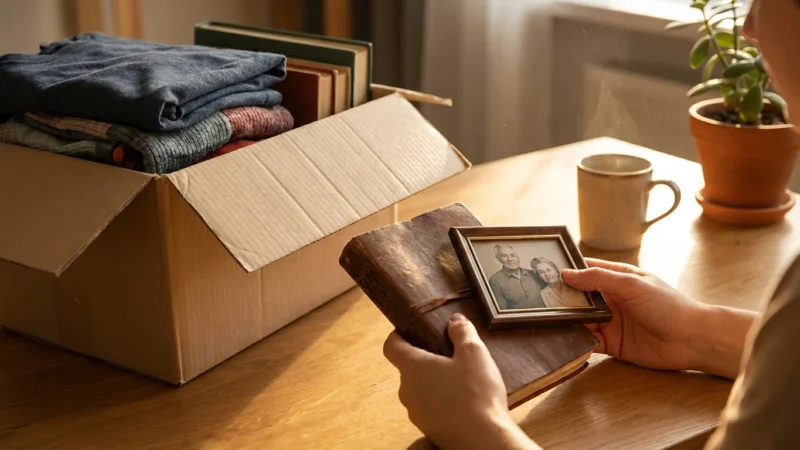
- Memory Boxes: Select a small, manageable number of truly irreplaceable sentimental items for a personal “memory box.” This allows you to keep a tangible connection to your past in a contained way. Dorothy has a small box with things like our kids’ first report cards and a dried flower from our wedding.
- Storytelling Sessions: Dedicate time to sharing stories associated with items you are letting go of. These narratives become the real heirlooms, passed down through conversation rather than physical objects.
- Focus on New Beginnings: Emphasize the freedom and opportunities that right-sized living offers. Imagine the new activities you can pursue, the new connections you can make, and the simplified daily life you will enjoy. For me, that meant playing pickleball four mornings a week and volunteering at the food bank. For Dorothy, it was taking up watercolor painting and finding her “Florida family.”
- Legacy Projects: Instead of focusing on “stuff,” think about legacy. Could you write down family stories? Start a new tradition? Invest in experiences with your family rather than material goods?
This shift in mindset transforms downsizing from a difficult chore into a meaningful chapter of life. You honor your past while eagerly embracing the future, bringing your family along on this positive journey.
Frequently Asked Questions
How do I handle family members who want everything?
When our kids expressed interest in items, I asked them to prioritize their top 3-5 most meaningful pieces. I explained that we were downsizing significantly, and not every item could be kept by every person.
I encouraged them to consider their own storage space and actual use for items. If direct negotiation is difficult, consider using a neutral third-party like a senior move manager or a lottery system for distribution. Remind everyone that the primary goal is to downsize your home, not to distribute all contents among family.
What if my family disagrees with my decision to downsize?
Open communication is paramount. I clearly explained my reasons for downsizing to Dorothy, focusing on the benefits to our lifestyle and reduced maintenance. I listened actively to her concerns and fears, validating her emotions without letting them derail our plans.
We involved our children in the planning stages to give them a sense of ownership. If their resistance stems from not wanting to help, offer to hire professional assistance to alleviate their burden, which is something I wish we had done more of.
How can I ensure fairness when distributing heirlooms?
Fairness often means equitable value, not necessarily equal items. I started by listing all significant heirlooms and, if appropriate, obtained professional appraisals for high-value items. I asked our children to list their top choices and why these items were important to them.
We facilitated discussions to find compromises. I kept a detailed spreadsheet to document all decisions to avoid future misunderstandings. Remember that your relationships are more important than any single object.
Is it okay to sell family items?
Yes, it is absolutely acceptable to sell family items. Your possessions are yours to manage as you see fit. Before selling, offer family members the opportunity to claim items they truly cherish, especially sentimental pieces.
For items with monetary value that no one in the family wants or has space for, selling can provide funds to support your new lifestyle or experiences. Be transparent with your family about your intentions to sell, explaining that these resources will benefit your future endeavors.
Selling some of our accumulated “stuff” definitely helped our relocation budget.
How do I manage my own emotional attachment to items during this process?
Acknowledge that letting go of items with deep sentimental value is difficult. I had to learn this from Dorothy. Give yourself permission to feel those emotions. Process items in small batches to avoid overwhelm.
For truly special items, consider taking a photograph, writing down the memory associated with it, or keeping a small, manageable “memory box” of a few irreplaceable items. Focus on the freedom and lighter living you gain. Remember that memories live in your heart, not just in your belongings.
Disclaimer: This article is for informational purposes only. Downsizing decisions are deeply personal and should be made at your own pace. If you’re struggling with the emotional aspects of letting go, consider speaking with a counselor or therapist who specializes in life transitions. For valuable items, consult with appraisers or estate professionals.









Leave a Reply