

What I Got Wrong About Choosing Our Retirement Community
If you’ve spent any time on this website, or really, any time talking to Dorothy and me, you probably know that I’m a man who generally prides himself on being right. It’s not a character flaw, mind you, just a logical outcome of careful research and methodical planning. Dorothy calls it “insufferable.” I call it “thorough.”
So, it’s not easy for me to admit when I’ve made a significant miscalculation. But when it came to choosing our 55+ community here in Sarasota, Florida, I have to confess: I got a few things wrong.
Not everything, mind you. My spreadsheet, with its 14 carefully selected variables, did lead us to a good place. But there were crucial elements, vital data points, that simply couldn’t be quantified in a column or ranked on a scale of one to ten. And those were the things I missed.
For nearly two years, while Dorothy was still teaching and I was already retired, I dedicated myself to the task of finding our next home. I saw it as an engineering problem: optimize for comfort, cost, climate, and community.
I built a comparison matrix that would make a NASA mission controller proud. I tracked HOA fees, property taxes, square footage, proximity to hospitals, golf courses, pickleball courts, and even the average number of sunny days.
I visited dozens of communities, took copious notes, and even developed a proprietary weighting system for my variables. I was convinced I had every angle covered.
And in some ways, I did.
What I Got Right (Mostly Thanks to the Spreadsheet)
My methodical approach certainly paid off in a few key areas.
First, location and climate. There was no arguing with the numbers when it came to Florida. We knew we wanted warmth, sunshine, and a break from the Columbus winters that had started to feel longer and grayer with each passing year. My research confirmed that Sarasota offered an excellent balance of cultural activities, medical facilities, and, of course, that year-round warmth we craved. We’re just a short drive from Siesta Key Beach, which the spreadsheet didn’t explicitly rank, but my eye for natural beauty certainly appreciated.
Second, financial viability. This was a non-negotiable for me. I ran scenarios for every community, factoring in HOA increases, property tax trends, and potential future expenses. My goal was to ensure that whatever community we chose, it wouldn’t become a financial burden.
We sold our 2,400 sq ft colonial on Elmwood Drive for a good price, and the smaller home here at Hawthorn Ridge made the transition smooth. We’re living comfortably, and that peace of mind is invaluable. My financial models, which Dorothy charmingly calls “a level of detail that belongs in a NASA mission,” proved accurate.
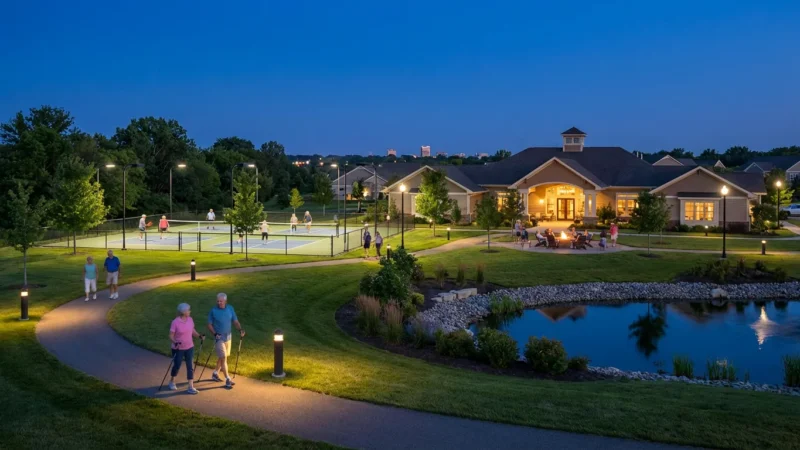
Third, amenities (the tangible ones). I made sure Hawthorn Ridge had a well-maintained pool, a fitness center, and, crucially for my post-retirement passion, excellent pickleball courts. I play four mornings a week now, and the courts here are top-notch.
The clubhouse is spacious, and the grounds are well-kept. These were all boxes my spreadsheet checked with flying colors, and I’m glad I prioritized them.
But here’s where the analysis began to fall short. The spreadsheet, as comprehensive as it was, couldn’t capture the essence of living in a place. It couldn’t measure the feeling, the atmosphere, the human element that ultimately defines a community.
What I Got Wrong (And What I’d Do Differently Now)
My biggest errors stemmed from an overreliance on quantifiable data and an undervaluation of the intangible.
Undervalued the Social Atmosphere
I looked at the amenities list: two pools, a fitness center, bocce ball, shuffleboard, a library, a craft room. I checked the box. “Robust amenity package,” I wrote in my notes. What I didn’t adequately consider was how those amenities fostered social interaction, or more importantly, what kind of social interaction.
My focus was on the what – the physical structures and offerings. I assumed that if the amenities were there, the people would naturally use them and socialize. I didn’t think about the how or the why. I’m a fairly self-sufficient person.
I enjoy my routines, my pickleball, my quiet time. I figured Dorothy would find her rhythm, and I’d find mine. I didn’t see the social fabric of a community as a primary variable. I saw it as a secondary outcome of good facilities.
I was wrong.
The truth is, the social atmosphere here at Hawthorn Ridge is one of its greatest strengths. It’s not just about having a pool; it’s about the friendly faces you see there every day, the impromptu conversations, the shared laughter. Dorothy, bless her heart, is a natural connector.
She talks to strangers at the pool, strikes up conversations at the mailbox, and has already built what she calls her “Florida family” of three genuine friends. I see now that a vibrant, welcoming social environment isn’t just a nice-to-have; it’s fundamental to happiness in retirement, especially when you’ve moved away from your established social circles.
My spreadsheet had a column for “Number of Social Clubs,” but it didn’t have one for “Genuine Warmth of Residents.” Big miss.
Dismissed Dorothy’s Gut Feeling
This is perhaps the most humbling admission. When we first visited Hawthorn Ridge, after a grueling day of touring three other communities that looked great on paper but felt sterile in person, Dorothy said, “Bill, this one just feels right.”
My immediate, engineer-brained response was, “Dorothy, ‘feels right’ isn’t a variable in my matrix. What specific criteria are you applying? What data supports this feeling?”
I remember her sigh. She just shook her head. “It’s not about data, Bill. It’s about how I feel when I walk through the clubhouse. It’s the way people smiled at us. It’s the buzz in the air.”
I, of course, politely but firmly dismissed this as subjective, unquantifiable input. My spreadsheet had objective measures: cost per square foot, amenity count, distance to nearest grocery store. “Feelings” were not part of the equation.
Now, almost two years in, I see she was absolutely right. The “buzz in the air” she talked about was the vibrant social energy I failed to quantify. The “way people smiled” was a direct indicator of the community’s welcoming culture.
Her gut feeling was picking up on qualitative data points that my logical framework simply couldn’t process. It was emotional intelligence, and it was far more accurate than my rigid analysis in this particular instance.
I’ve learned that sometimes, the most important metrics are the ones that reside in the heart, not on a spreadsheet.
Overweighted Cost Per Square Foot, Underweighted Community Culture
In my pursuit of value, I became overly focused on the financial efficiency of a community – how much bang we got for our buck in terms of physical space and amenities. I’d compare HOA fees against square footage, calculating a per-square-foot cost for living, almost like a commercial real estate deal.
This led me to seriously consider a community just a bit further south that offered slightly larger homes for a marginally lower overall cost. On paper, it was a more “efficient” choice. It had a golf course, which I don’t play, but I figured it added value.
What I didn’t adequately weigh was the culture of that community. During our brief visit, it felt a little… quiet. Reserved. The residents we saw seemed to keep to themselves. I remember remarking to Dorothy, “Well, it’s certainly peaceful.” She just gave me that look again. “Peaceful, or just not very friendly?” she asked. I chalked it up to bad timing, perhaps an off-day.
Hawthorn Ridge, by comparison, might have cost us a few more dollars per square foot, but the community culture here is priceless. It’s an active, engaged, and genuinely friendly place.
People volunteer, they organize events, they look out for each other. That “buzz” Dorothy felt? It’s the hum of a healthy, connected community. You can’t put a price on feeling like you belong, like you’re part of something. My spreadsheet calculated cost efficiency; it failed to calculate belonging efficiency.
Didn’t Talk to Enough Actual Residents
This is a classic oversight for someone who relies heavily on official documentation. I read every brochure. I scoured every website. I attended every sales presentation. I even cross-referenced online reviews, though I took those with a grain of salt, knowing how extreme opinions can be.
What I didn’t do enough of was simply talk to people who lived there. I had a few brief chats during tours, mostly superficial pleasantries. But I didn’t sit down with half a dozen residents, unsolicited, and ask them the tough questions: “What do you really like about living here? What are the biggest frustrations? How’s the management? Is there anything you wish you’d known before moving in?”
I relied on the curated experience provided by the sales staff. Of course, they’re going to highlight the positives. My engineering background taught me to verify data, but in this case, I didn’t go deep enough into the primary source – the actual lived experience of the residents.
I was so busy comparing the stated facts and figures that I neglected the invaluable anecdotal evidence that would have given me a much richer, more accurate picture. Had I done so, I would have understood the importance of the social atmosphere and community culture much earlier in the process.
Almost Chose a Cheaper Community with Terrible Management
This was a close call, and a stark reminder of the practical consequences of my blind spots. There was a community about 45 minutes from here that consistently ranked high in my “cost efficiency” column. Lower HOA fees, slightly newer construction, and a very attractive initial purchase price. On paper, it was a clear winner in several categories.
I toured it twice. It looked clean, the homes were well-appointed, and the sales team was incredibly persuasive. What I failed to dig into, beyond their glossy brochures, was the reputation of the management company.
I saw a few negative comments online but dismissed them as isolated incidents or disgruntled individuals. My focus was on the physical assets and the numbers.
It wasn’t until after we had pretty much decided on Hawthorn Ridge, and I was doing some final, “just to be sure” checks, that I stumbled upon a local forum dedicated to 55+ communities in the area.
And there, the truth about that other community’s management was laid bare: unresponsive, arbitrary rule changes, poor maintenance follow-through, and a general lack of transparency. Had I pulled the trigger on that “cheaper” option, we would have saved a few thousand dollars upfront, only to inherit a mountain of headaches and frustrations that would have severely impacted our quality of life.
The initial cost savings would have been utterly dwarfed by the ongoing stress and dissatisfaction. My spreadsheet prioritized low cost; it failed to flag high exasperation.
What I’d Tell Other Couples Doing This Research
So, having learned these lessons the hard way, what would I tell you if you’re embarking on this journey?
- Balance the Tangible with the Intangible: Yes, do your homework on the financials, the amenities, the location. Those are critical. But dedicate just as much energy to understanding the feel of the place. Walk around, sit in the common areas, observe. Are people smiling? Are they interacting? Does it feel welcoming?
- Listen to Your Gut (and Your Partner’s): Especially if your partner is like Dorothy. Your “feelings” are not irrational; they’re often a subconscious processing of countless subtle cues that your logical brain might miss. If something “feels right” or “feels off,” pay attention. It’s valid data.
- Prioritize Community Culture Over Cost Per Square Foot: A slightly higher HOA fee or purchase price for a community with a vibrant, supportive, and friendly culture is almost always a better investment than saving a few dollars in a place that feels isolating or poorly managed. Happiness in retirement is more about connection than calculation.
- Talk to Residents – Unfiltered: Don’t just rely on the sales pitch. Ask to speak with residents who aren’t part of the “ambassador” program. Go to the pool, the coffee shop, or a community event and strike up conversations. Ask open-ended questions. Get the real story – the good, the bad, and the ugly. This is the most valuable data you can collect.
- Research Management Companies Thoroughly: This is a crucial one that I nearly overlooked. A great community can be ruined by poor management. Look up the management company online, check local forums, and ask residents directly about their experiences. Their responsiveness, transparency, and competence are paramount.
The Ultimate Concession
Looking back, my spreadsheet was a marvel of organization and analytical rigor. It did its job, providing a solid framework for our decision. But it was incomplete. It lacked the columns for “Genuine Friendship Potential,” “Sense of Belonging,” and “Overall Happiness Quotient.” Those were the variables Dorothy instinctively understood, and it took me a full year of living here at Hawthorn Ridge to truly appreciate their weight.
She was right. Her instinct was right. And my spreadsheet, for all its meticulous detail, was missing the most important data of all: the human heart.






Leave a Reply